
Welcome back to our Examination Paper Analysis series!
In this article, we will be analysing a question on the topic of Adaptations from the 2014 Yew Tee Primary School (YTPS) P6 SA2 Examination Paper.
I will be sharing an answering technique that you can use for open-ended questions that require you to select from available choices and explain your answer.
Read Also:
Let’s Take A Look At This Question
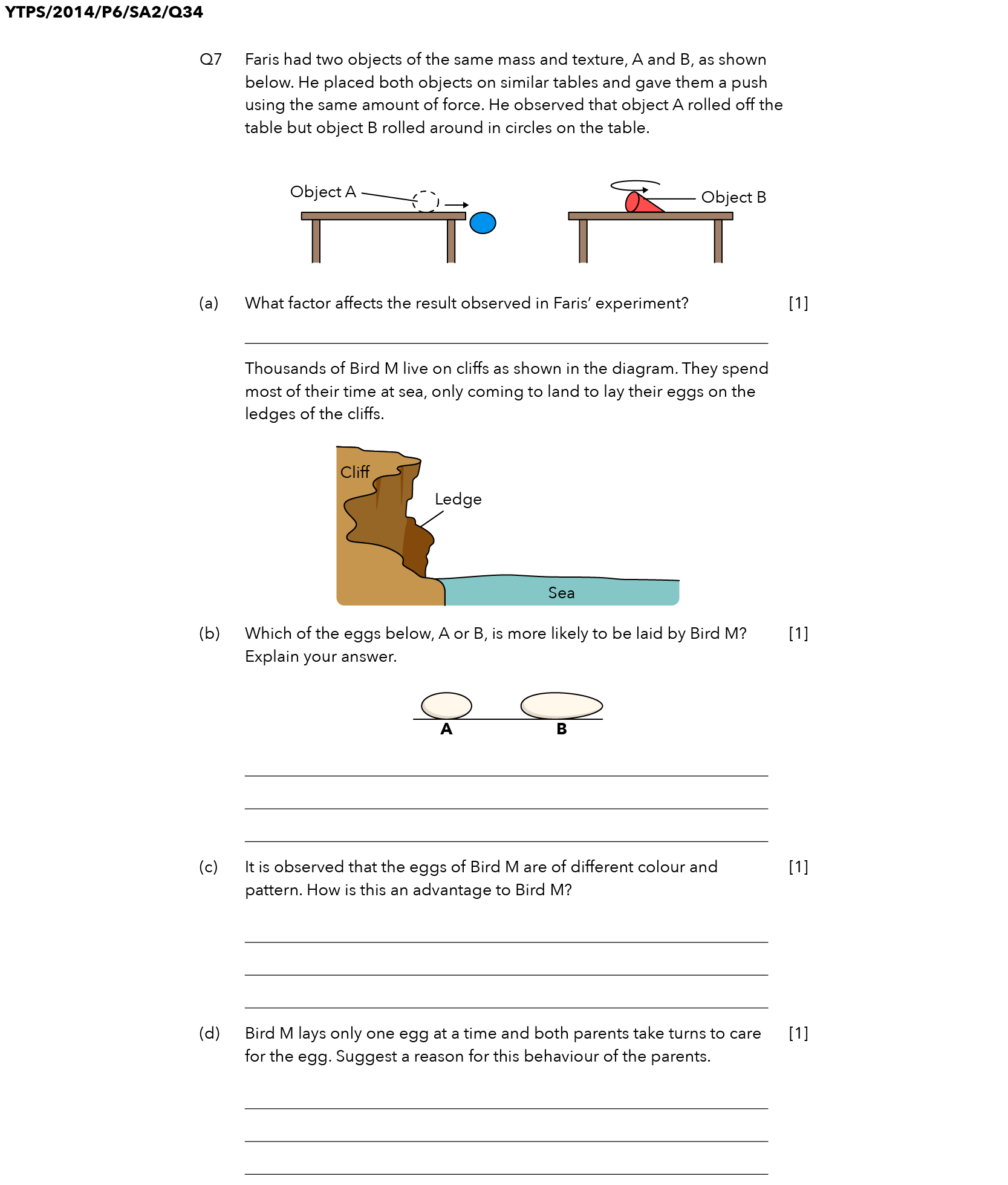
Source: Yew Tee Primary School – 2014 P6 SA2 Examination Paper [Q34]
Let’s Analyse Part (A)
If you compare the two objects in Faris’ experiment, what do you think is the difference between them? You can see in the diagrams below that Object A is in the shape of a circle, while Object B is cone-shaped.

Therefore, the factor that affects the results is the shape of the object.
Suggested Answer For Part (A)
It is the shape of the object.
Let’s Analyse Part (B)
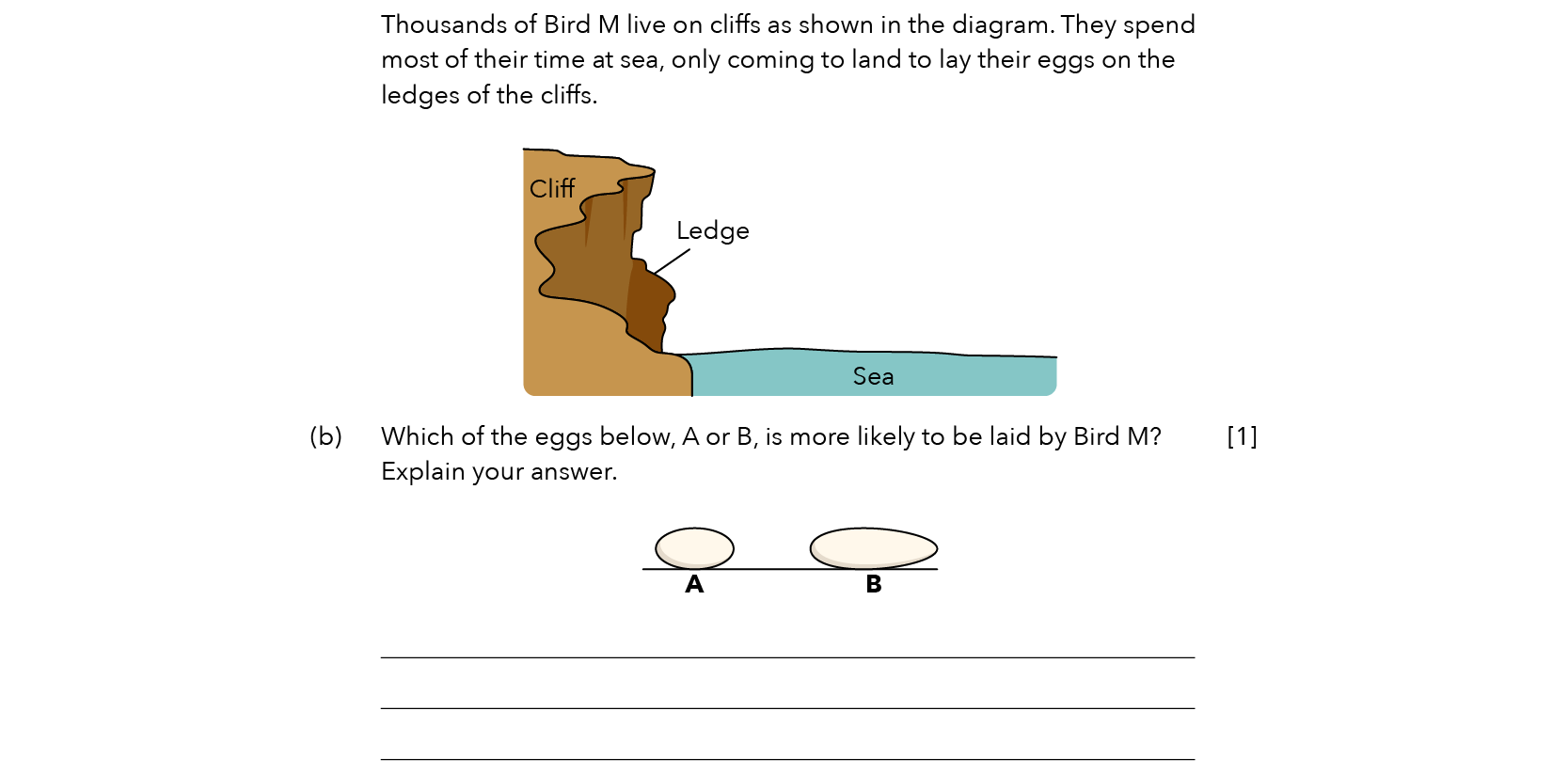
Source: Yew Tee Primary School – 2014 P6 SA2 Examination Paper [Q34]
The question on part (b) wants us to choose which of the eggs, A or B, is most likely to be laid by bird M. It also wants us to explain our answer.

Whenever you are told to make a choice and then explain your answer, what answering template should you use?
📝 Use The CUE Technique 📝
C stands for ‘Choose’.
U stands for ‘Use the data’.
E stands for ‘Explain the data’.
Let’s figure out which of the eggs is more likely to be laid by bird M. If you take a look at the two eggs, what’s the difference between them? You can see that egg A is more circular, while egg B is more elongated.

Based on this observation, how can we tell which of the eggs is more likely to be laid by bird M? Earlier, we had Objects A and B on a table, and Object A was the one that fell off the table. Object A is more circular compared to object B.
Meanwhile, Object B rolled around in circles on the table. Did it fall off? No.
If this egg is laid by bird M on the ledges of the cliffs, do you want it to roll off? No, you want to choose an egg that is more likely to roll in circles.
Is it going to be egg A which is more circular or egg B which looks more like the cone? For the first step in the CUE technique, we know that we should ‘Choose’ egg B as our answer.

The second step is to ‘Use the data’. What’s the data that we can use from this diagram? It is the fact that egg B is more elongated than egg A.
Finally, we must ‘Explain the data’. How do we explain the data? Since the egg is more elongated, it is going to roll in circles.
Because it rolls around in circles, do you think the egg will roll off the cliff? No, this characteristic will prevent the egg from rolling down the cliff.

Suggested Answer For Part (B)
Choose: Egg B.
Use the data: Egg B is more oval/elongated than egg A.
Explain the data: Thus, when egg B rolls, it will roll in circles. This prevents egg B from rolling off the cliff easily.
Let’s Analyse Part (C)

Source: Yew Tee Primary School – 2014 P6 SA2 Examination Paper [Q34]
To answer the question, let me provide a scenario as an example. When you go to school, does everyone carry the same type of backpack? I’m sure you and your classmates have different backpacks!
Can you imagine what would happen if everyone were to carry the same kind of backpack in school? When you put your bags in class and you go for recess, when you come back, you will have a hard time recognising which one is yours.

When you have a different backpack from your friends in class, can you tell which is your bag and which is someone else’s? Definitely! It is the same situation for bird M.
How many birds M live on the cliff? There are thousands of birds M. If they lay eggs of the same colour and pattern, do you think the mommy and daddy birds can recognise which eggs are theirs? No.

When the eggs are of different colours and patterns, what is the advantage then? This allows the parents to recognise them more easily.
Suggested Answer For Part (C)
Since thousands of birds M live on the cliff, having eggs of different colours and patterns allows the parents to be able to identify/recognise their eggs more easily.
Let’s Analyse Part (D)

Source: Yew Tee Primary School – 2014 P6 SA2 Examination Paper [Q34]
For most animals that lay eggs, do the parents usually take care of the eggs? No.
If you take a look at the frog, for example, it lays hundreds of eggs at one time. Do you think that the frog can care for all the eggs that it has laid? No.

If the frog laid that much, would all 100 of the tadpoles die? No. This is why animals do not usually care for their eggs if they lay many eggs at a time.
This is because even if some eggs are eaten by predators, some of the remaining eggs would still have a chance to hatch to become young.
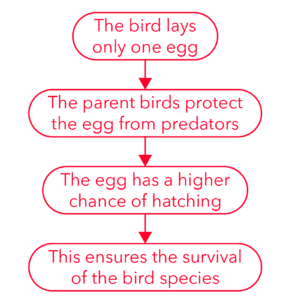
However, bird M only lays one egg at a time. Parents take care of the egg so that they can protect it from predators and have a higher chance of hatching.
Once the egg hatches, it will form the young. After some time, the young can develop into an adult.
What is so important about the adult stage? Birds in the adult stage can reproduce, and when they reproduce, this will ensure the survival of their kind.
Suggested Answer For Part (D)
This behaviour helps to protect the egg from predators, increasing the chances that the egg would hatch to form the young, which will develop into adults and reproduce, ensuring the survival of their kind.
Conclusion
We have learnt today that some bird eggs are more elongated so they would roll around and not easily fall off the cliff. It’s interesting to note that birds’ eggs have this adaptation to ensure that they will survive in their environment.
I hope that after reading this blog post, you can now apply the CUE technique — Choose, Use the data, and Explain the data — when answering open-ended questions (OEQs). This will help you phrase your answers more effectively and score well in your OEQs!
Check out our other articles on Adaptations and continue to keep a lookout for more articles! 🙂
1 comment