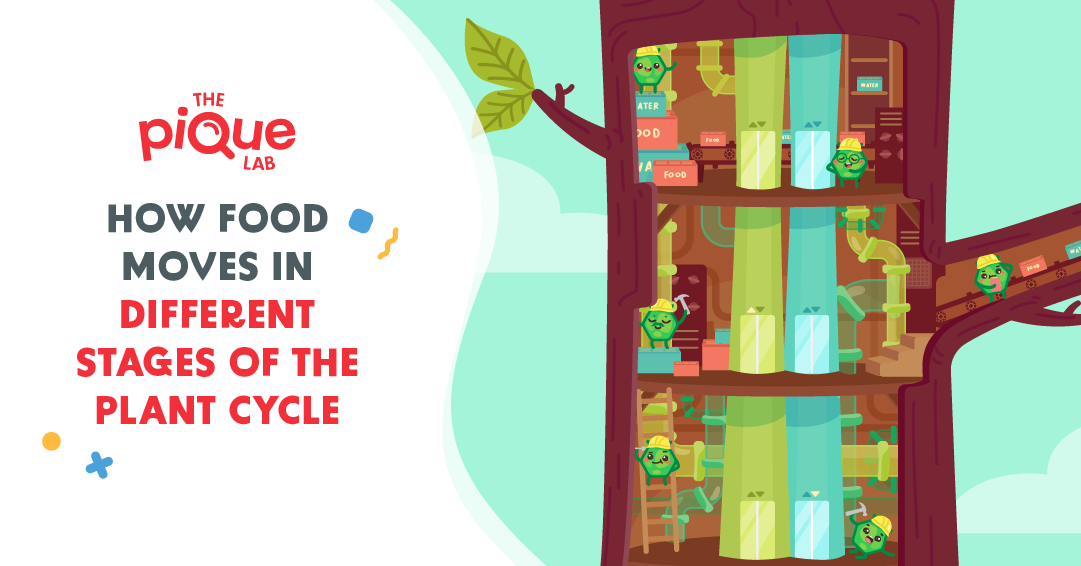

When discussing the movement of food within a plant, there are a few questions we need to ask ourselves:
- Which stage is the plant at?
- Has the plant developed its true leaves or does it still depend on its seed leaves for food?
- Where are the positions of the seed leaves/true leaves?
Today, I will be helping you to gain a better understanding of the movement of food within the plant:
- During the seedling stage (before the true leaves are formed)
- At the young plant stage (where the plant has developed its true leaves).
First, we need to recall the life cycle of a plant before analysing each stage.

Life Cycle Of A Plant
The first stage starts from a seed. For a seed to develop into a seedling, it will have to undergo germination.
Do you remember the 3 conditions needed for a seed to germinate? All you need to remember is WOW!
W – Water
O – Oxygen
W – Warmth
We were taught that food is made by the leaves through photosynthesis.
However, when the seed germinates, it has yet to develop its true leaves.
Think about it: Where does the seed get its food from?
Source of food in a seedling (before true leaves are formed)
Beneath the seed coat lies the seed leaves where it stores food.
Food in the seed leaves is used in the process of respiration to release energy for the growth of the seedling.
Source of food in a seedling (after true leaves are formed)
The seedling continues to grow and soon develops its true leaves where it no longer depends on the seed leaves for food.
At this point, examiners are fond of asking the question “Why?”.
Question: Are you able to explain why the seedling no longer depends on the seed leaves for food?
Answer: The true leaves of the seedling contain chloroplasts, which contain chlorophyll to trap sunlight for photosynthesis to make its own food.
Read Also:
Now, let’s go deeper and analyse the parts of the plant at various stages.

Roots
When the seed first germinates, the roots will grow downward first to absorb water and mineral salts from the soil and anchor the plant firmly to the ground.
Water absorbed by the roots will be transported upwards to the rest of the plant. The roots will also receive food from the seed leaves for respiration to release energy.
With reference to the diagram above, the food in the seed leaves, which are above the roots is transported downwards to reach the roots.
Shoot
At this stage, the seedling has yet to develop its true leaves. Hence, it is unable to trap sunlight for photosynthesis to make its own food. The shoot will also have to depend on the seed leaves for food.
Thus, the food stored in the seed leaves, which is now below the shoot, needs to be transported upwards to reach the shoot.

True Leaves
After the true leaves are developed, the young plant will now be able to carry out photosynthesis. The true leaves contain chloroplasts, which contain chlorophyll to trap sunlight for photosynthesis to make food.
The movement of food would be in an upwards and downwards direction to reach all parts of the plant.
How about the movement of water in the plant? You might wonder.
Since water is absorbed ONLY by the roots, the movement of water in the plant is always from the roots UPWARDS to all parts of the plant.
Now, Try The Following Question:

Source: Nanyang Primary School – 2015 P6 CA1 Examination Paper [Q1]
Did you get Option (2) as your answer?
I hope that this article has clarified any confusion that you might have regarding the movement of food within a plant at different stages.
Stay tuned for more articles!
6 comments