

Introduction
At The Pique Lab, we use acronyms so that students can easily remember key concepts for different topics!
One important acronym to remember when doing Fungi & Bacteria questions is WOW.
Let’s recap! Mould is a type of fungi, and like all fungi, it needs certain conditions to grow. What are the 3 things that mould needs to grow?
🧀 Mould Needs WOW To Grow 🧀
Water 💧
Oxygen 🌬
Warmth 🔥
In this blog post, we will be analysing how the presence of these factors affects the amount of mould growing on cheese.
Alternatively, you can also watch my explainer video on our YouTube channel for free!

Read Also:
Let’s Take A Look At This Fungi & Bacteria Question
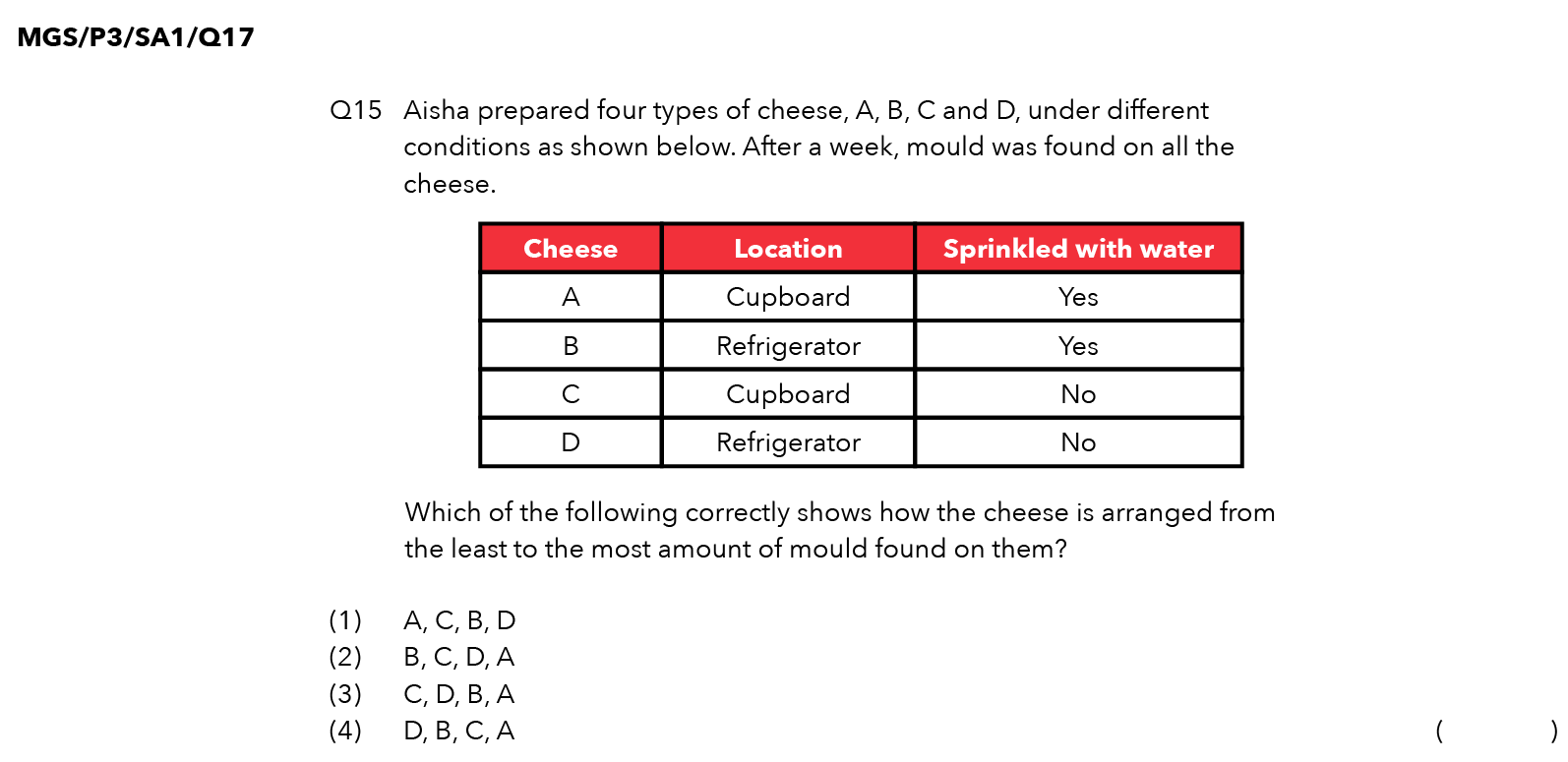
Source: Methodist Girls’ School – 2018 P3 SA1 Examination Paper [Q17]
Thought Process
Before we begin, let me ask you this question: Where do you normally store cheese at home?
You usually store them in the refrigerator, right?
Why do you do this? This is because the refrigerator is cold!
🧀 Remember That Mould Needs Warmth To Grow 🧀
Therefore, placing the cheese inside the refrigerator will help slow down the growth of mould.
Let us begin analysing the question.
If I want the cheese to have the least mould, should I store it in the cupboard or the refrigerator?
I should store the cheese in the refrigerator!

Now, we have two options where the cheese is placed in the refrigerator — Option B and Option D.
Let’s now analyse the difference between these options.
Cheese B is sprinkled with water, while Cheese D is not sprinkled with water.

How do we know which cheese has less mould?
Remember, one of the conditions that needs to be met for mould to grow is the presence of water.
So, if I want the cheese to have the least mould, should the cheese be sprinkled with water?
No! Hence, Cheese D would have the least mould.
Now, let us talk about the cheese with the most mould.
If I want my cheese to have the most mould, the cheese should be stored in the cupboard.
So, we have two options — Cheese A and C.

Let us analyse these two options.
Cheese A is sprinkled with water, while Cheese C is not sprinkled with water.

Remember that water there needs to be water for the mould to grow.
So, if I want the cheese to have the most mould, should the cheese be sprinkled with water?
Yes! Hence, Cheese A would have the most mould!
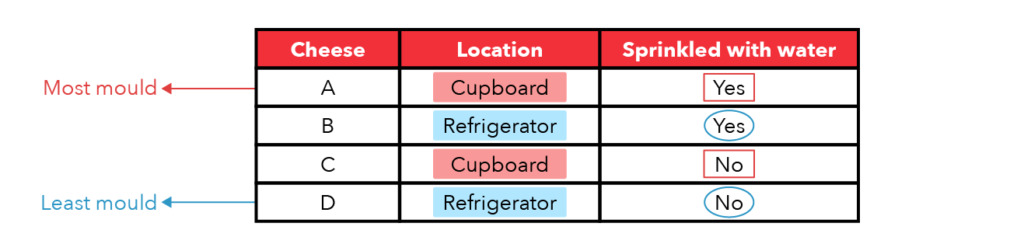
Now, we are ready to arrange them.
Recall that the question wants us to arrange the cheese with the least amount to the most amount of mould.

We have concluded that Cheese D would have the least mould and Cheese A would have the most mould.
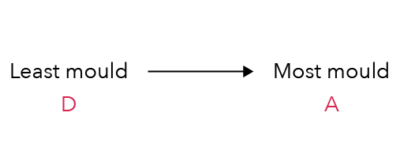
Therefore, the answer should be Option (4).
Suggested Answer
Option (4)
Conclusion
I hope that after reading this Fungi & Bacteria blog post, you have gained a better understanding of how to use 3 important conditions for mould growth to tackle application questions like this:
Water 💧
Oxygen 🌬
Warmth 🔥
But aside from knowing these, you should also be able to analyse how their presence or absence can contribute to the growth of mould.
Stay tuned for more blog posts highlighting acronyms to help you remember key concepts for different topics!